
US India News: How the $500B Trade Deal Impacts Sensex, Nifty & Pharma
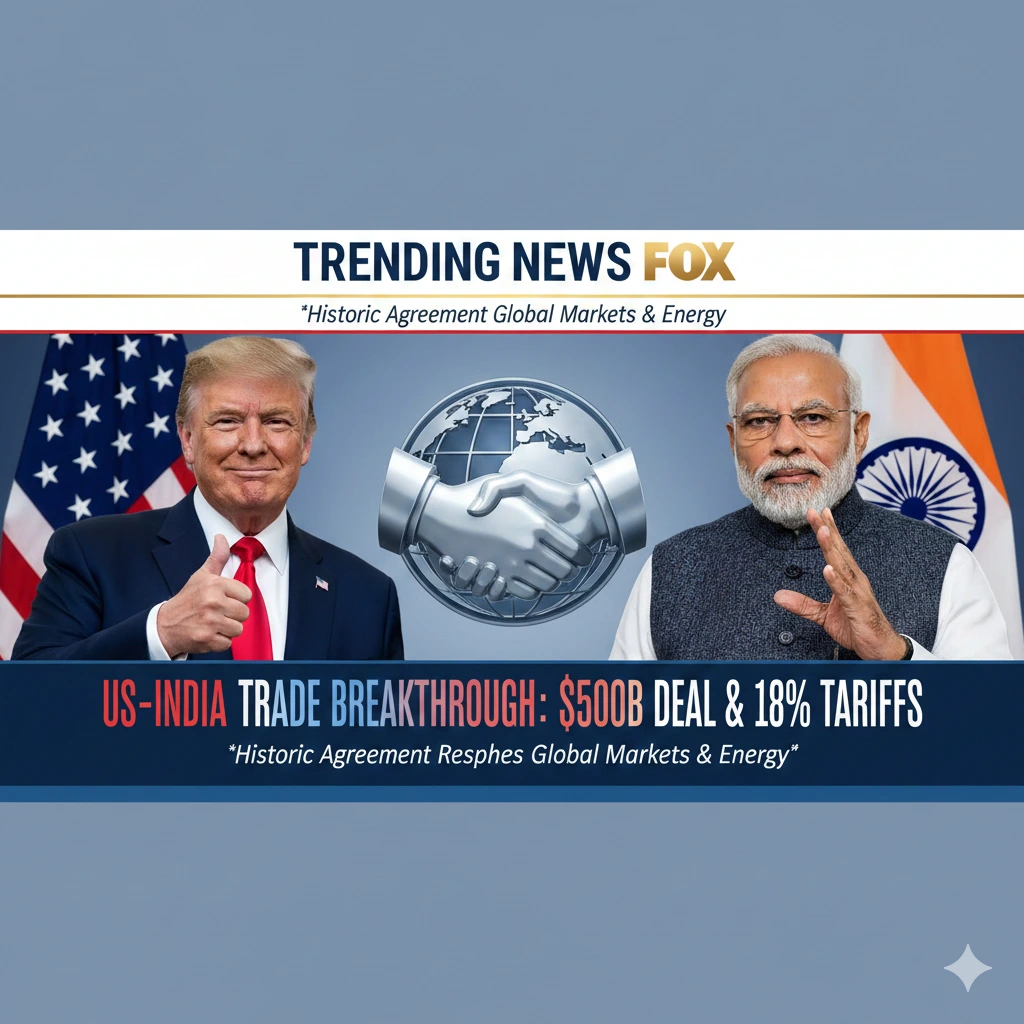
US India News: Markets surge as the US-India trade deal lowers reciprocal tariffs to 18%. Discover who benefits and who suffers from the Trump-Modi agreement. Examine the impact on Indian IT and Pharma sectors. Consider the $500 billion energy commitment.
By Trending News Fox News & Media Team Published: February 4, 2026 | 10:00 PM IST
US India News: Trump and Modi Seal Historic $500 Billion Deal to Reset Global Markets
NEW DELHI / WASHINGTON D.C. — In a move that has sent shockwaves through global markets and redefined the geopolitical landscape of 2026, U.S. President Donald Trump and Indian Prime Minister Narendra Modi have announced a landmark bilateral trade agreement. The deal, finalized on February 2, 2026, effectively ends a year of escalating trade tensions. It positions India as a primary strategic and economic partner for the United States in the Indo-Pacific.
US India News: A Comprehensive Overview
The centerpieces of the agreement include a massive reduction in U.S. tariffs on Indian goods. India is pivoting its energy procurement away from Russia. New Delhi plans to buy over $500 billion in American goods. This commitment extends over the coming years.
The Tariff “Truce”: From 50% to 18%
The most immediate impact of the deal is the dramatic de-escalation of the “tariff war.” This conflict had plagued the two nations since mid-2025. After a direct phone call between the two leaders, President Trump announced that the U.S. would slash its reciprocal tariff on Indian exports from 25% to 18%.
More significantly, the White House confirmed the removal of an extra 25% punitive duty. This duty had been applied to Indian goods. This duty was completely removed. This was last August. That penalty was originally tied to India’s continued buying of Russian crude oil.
US India News: Bridging Cultures and Economies
We have a friendship and respect for Prime Minister Modi. At his ask, we agreed to a Trade Deal effective instantly. This includes lowering tariffs from 25% to 18%,” Trump posted on Truth Social.
India reduced the effective tariff rate from a punishing 50% to just 18%. As a result, it now enjoys a more favorable trade position than many of its regional competitors. For comparison:
- India: 18%
- ASEAN Nations: 19%
- Vietnam/Bangladesh: 20%
- China: 30–35% (plus extra penalties)
The Energy Pivot: Goodbye Russian Oil, Hello American Shale
The most significant geopolitical concession in the deal is India’s reported agreement. India agreed to halt or significantly reduce its intake of Russian oil. Since the onset of the Ukraine conflict, India had been a major buyer of discounted Russian crude. This was a point of major friction with Washington.
Under the new terms, India will redirect its massive energy demand toward the United States and Venezuela. This shift is a dual victory for the Trump administration. It boosts the American energy sector. It further isolates Moscow’s economy.

Key Commitments in the $500 Billion Package: US India News
- Energy & Coal: Massive long-term contracts for U.S. liquefied natural gas (LNG) and coal.
- Technology: Increased procurement of American-made semiconductors and telecommunications equipment.
- Agriculture: Greater market access for U.S. tree nuts, cotton, and soybean oil.
- Defense & Nuclear: Deepened cooperation under the SHANTI Act (2025), allowing U.S. firms to enter India’s civil nuclear sector.
Market Reactions: Sensex and Nifty Surge
The news of the “Trump-Modi Truce” triggered an immediate rally in the Indian stock markets. On Tuesday, February 3, the Sensex and Nifty both surged nearly 3%. Gains in the pharmaceutical, textile, and IT sectors led this surge.
Industry experts believe the 18% tariff rate will offer a much-needed “smooth landing” for Indian exporters. Namit Joshi, Chairman of Pharmexcil, noted that the U.S. market accounts for nearly 40% of India’s pharmaceutical revenue, making this reduction “incrementally positive” for the sector’s growth.
The Indian Rupee also saw a sharp recovery against the Dollar. The deal removed the looming cloud of a full-scale trade war. It encouraged the return of Foreign Institutional Investors (FIIs).
Domestic Pushback: “Surrender” or “Success”?
Despite the market optimism, the deal has not been without controversy in India. The opposition Congress Party and various farmer unions have slammed the agreement, alleging that PM Modi has “succumbed to U.S. imperialism.”
Why Is US India News Important for Global Affairs?
Critics argue that the commitment to reduce Indian tariffs on U.S. agricultural products to “near zero” will devastate local farmers. The Samyukt Kisan Morcha (SKM) issued a stern statement warning that flooding the Indian market with subsidized U.S. dairy and poultry would trigger widespread rural distress.
PM Modi, nonetheless, framed the deal as a victory for the “Make in India” initiative. On X (formerly Twitter), he thanked President Trump. He stated, “When two large economies and the world’s largest democracies work together, it benefits our people. It also unlocks immense opportunities.”
The Road Ahead: Challenges and “Loose Ends”
The announcement is a major breakthrough. Yet, trade analysts warn that the $500 billion figure is more aspirational than immediate. In 2024, total U.S. goods and services exports to India totaled roughly $83 billion—meaning a $500 billion target shows a nearly 500% increase.
Furthermore, several “loose ends” persist:
- Intellectual Property (IP): There are concerns that the U.S. will pressure India to align its patent laws with American standards. This change significantly raises the cost of healthcare. It also increase the price of generic medicines in India.
- Strategic Autonomy: While India is pivoting away from Russian oil, Russia remains its largest supplier of defense hardware. Maintaining this “Special and Privileged Strategic Partnership” with Moscow is crucial. At the same time, building ties with Washington will need a careful approach from Indian diplomats.
- The China Factor: India is securing a lower tariff rate than China and Vietnam. This move positions India as a premier choice for global supply chains. These chains seek to “de-risk” from Beijing.
Conclusion: A “Mega Partnership” for 2026
The 2026 U.S.-India Trade Deal signifies more than just a commercial agreement; it is a recalibration of the global order. For President Trump, it fulfills the “Buy American” promise and secures a key ally against China. For Prime Minister Modi, it protects India’s export economy and ensures energy security via a “trusted partner.”
As U.S. Ambassador to India Sergio Gor put it, the relationship now has “limitless potential.” Whether the two nations can navigate the domestic political hurdles remains to be seen. Addressing the technical barriers is another challenge. For now, the “Trump-Modi” duo has successfully pulled the world’s two largest democracies back from the brink of economic conflict.
Trending News Fox will continue to watch this story. They will give updates as the full legal text of the agreement is released later this week.
Here are the most important questions and answers based on the February 2026 breakthrough.
US India News: Frequently Asked Questions
1. What is the new tariff rate for Indian goods entering the U.S.?
The effective tariff rate for Indian exports to the United States has been reduced to 18%. This is a massive drop from the earlier peak of 50%. The peak included a 25% reciprocal tariff. There was also an extra 25% punitive penalty linked to India’s Russian oil imports.
2. Is India really going to stop buying Russian oil?
Yes. The agreement was announced on February 2, 2026. As part of it, India has committed to cease new orders of Russian crude oil. While existing contracts will be honored, Indian refiners are expected to pivot toward U.S. shale oil, coal, and Venezuelan crude to meet domestic energy demands.
3. What does the $500 billion “Buy American” pledge include?
The $500 billion commitment is a multi-year procurement plan. It primarily covers:
- Energy: Liquefied Natural Gas (LNG) and American coal.
- Defense: Advanced aviation technology and jet engines.
- Aviation: Large-scale commercial airplane orders for Indian carriers.
- Agriculture: Increased imports of U.S. cotton, tree nuts, and non-GM soy.
4. How does this deal affect the Indian stock market (Sensex and Nifty)?
After the announcement, the Sensex and Nifty 50 both surged by nearly 3%. Nifty experienced intraday jumps of over 4%. The deal provides long-term stability for export-heavy sectors like Pharmaceuticals, and IT. It also benefits Textiles and Gems & Jewelry. Earlier, these sectors were hammered by high U.S. tariffs.
5. Will India’s agricultural sector be affected?
The Indian government is led by Commerce Minister Piyush Goyal. It has clarified that sensitive sectors like dairy and core food crops stay protected. While India is reducing barriers on some U.S. agricultural products to move toward “near zero” tariffs, it has made specific exemptions. These exemptions safeguard the livelihoods of Indian farmers.
6. How does India’s 18% tariff compare to other countries?
With this deal, India now holds a significant competitive advantage in the U.S. market:
- India: 18%
- ASEAN / Indonesia / Pakistan: 19%
- Vietnam / Bangladesh: 20%
- China: 34% or higher
7. When do these changes take effect?
President Trump stated the deal is effective instantly as of February 2, 2026. Nonetheless, industry experts note that a formal Presidential Proclamation and Federal Register notice are required in the U.S. for the tariff changes to be fully codified.
Disclaimer: Trending News Fox provides news for informational purposes only. This content does not constitute financial or legal advice. Market data is provided “as-is” and can be delayed. The content was generated based on verified news data as of February 2026. It was later reviewed, edited, and fact-checked by our editorial team. This ensures quality and adherence to journalistic standards.
Discover more from Trending News Fox
Subscribe to get the latest posts sent to your email.